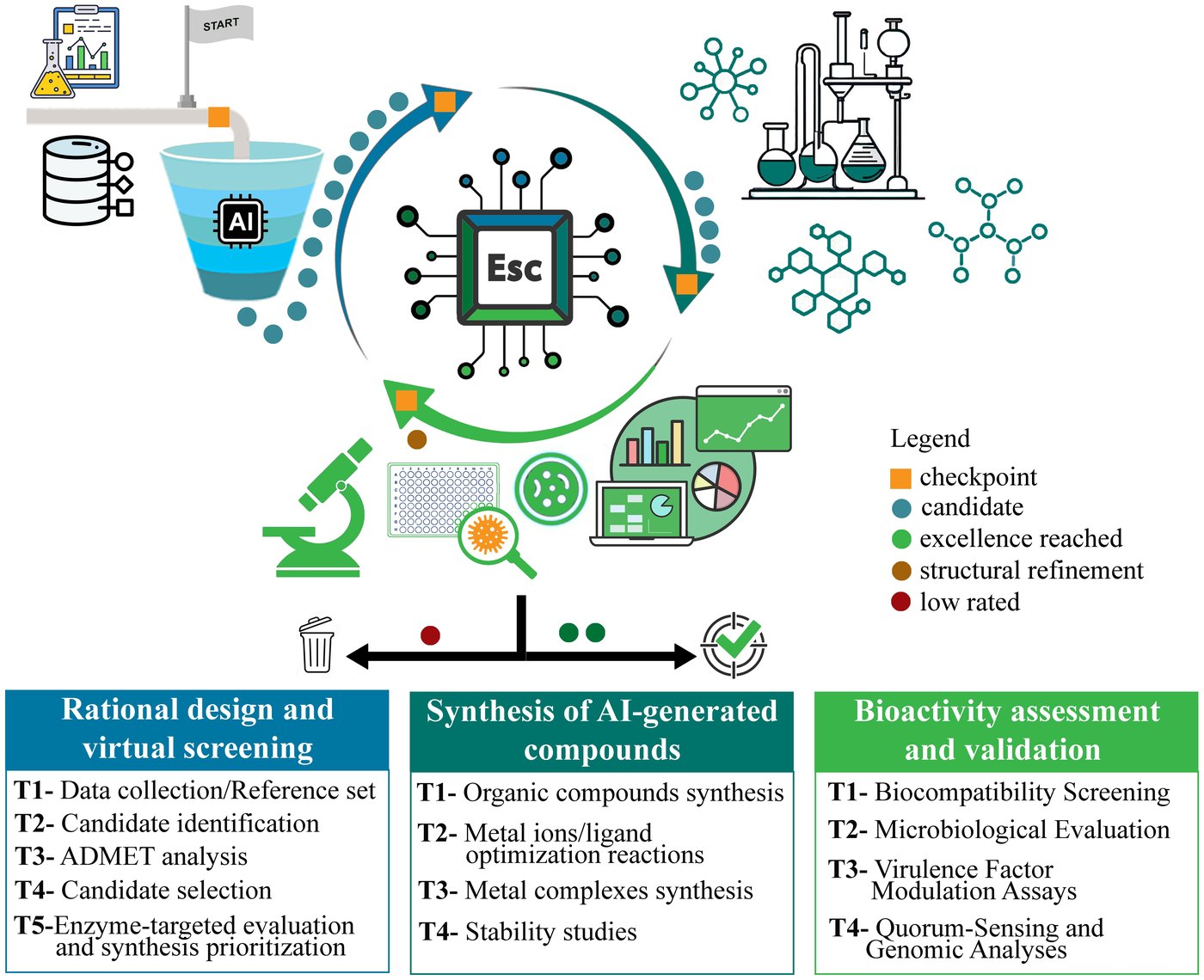
AMR in ESKAPE bacteria exposes a paradox: where the clinical need is highest, discovery pipelines remain conservative. Most programs still rely on flat, purely organic scaffolds optimized for planktonic growth, while metal complexes with rich 3D geometries, redox activity and ligand-exchange chemistry are only sporadically explored, and almost never in a systematic, ESKAPE-centered way. In parallel, powerful AI and machine-learning tools rarely “talk” to real ESKAPE phenotypes.
This strategic project offers a compact but conceptually ambitious contribution by building an integrated loop that connects: (i) AI-assisted, target-based design of organic ligands and their metal complexes; (ii) rational filtering using docking and key physicochemical descriptors; and (iii) harmonized experimental readouts on antimicrobial and resistance-modifying activity against representative ESKAPE strains. The strategic project will explicitly quantify how docking scores, molecular properties and metal-coordination patterns translate into changes in susceptibility to clinically used antibiotics.
The strategic project will generate a series of novel metal-organic entities derived from small antimicrobial molecules and medicinally relevant metal ions. For this series, we will obtain coherent data that link structure, predicted target engagement, basic toxicity and ESKAPE phenotypes, enabling exploratory QSAR and machine-learning models tailored to resistant hospital pathogens. The innovative element lies not only in the individual compounds, but in the deliberately circular workflow where AI, synthetic chemistry and mechanism-oriented microbiology iteratively inform each other, providing a reusable framework for rational design of metal-organic agents against high-priority ESKAPE pathogens.
In doing so, the strategic project will move the field beyond descriptive screening of complexes and towards a mechanistically grounded understanding of how metal-organic architectures can be tuned to disarm high-priority ESKAPE pathogens.

Funded by: Serbian Academy of Sciences and Arts. Strategic project of the SASA Science Fund (No. 01-2026).
SmartLoop
We combine artificial intelligence, synthetic chemistry and microbiology to design, synthesize and evaluate new metal-organic compounds with antibacterial and resistance-modifying activity.