AI-driven Design
Machine learning and molecular docking for compound selection and design.
Development of next-generation antibacterial metalorganics to escape infections caused by
Escape from ESKAPE
About the strategic project
The overall objective is to develop and validate an AI-assisted, target-driven pipeline for the design and experimental evaluation of new organic ligands and their metal complexes with antimicrobial and resistance-modifying activity against ESKAPE pathogens.
Read moreTo select relevant molecular targets linked to resistance and/or virulence in ESKAPE bacteria, and to use AI/machine-learning (ML) models and molecular docking to prioritize and/or design at least 10 organic compounds and 20 corresponding metal complexes.
To synthesize and fully characterize the selected compounds, ensuring suitable stability and solubility profiles for biological testing.
To determine antimicrobial and resistance-modifying activity of all candidates in vitro against the ESKAPE panel and to identify at least three lead compounds that either show relevant intrinsic activity or demonstrate clear synergistic effects in combination with at least one clinically used antibiotic.
To evaluate preliminary safety of lead candidates in standard cell-based cytotoxicity assays and to build integrative structure–activity models linking in silico descriptors with experimental outcomes.
Approach
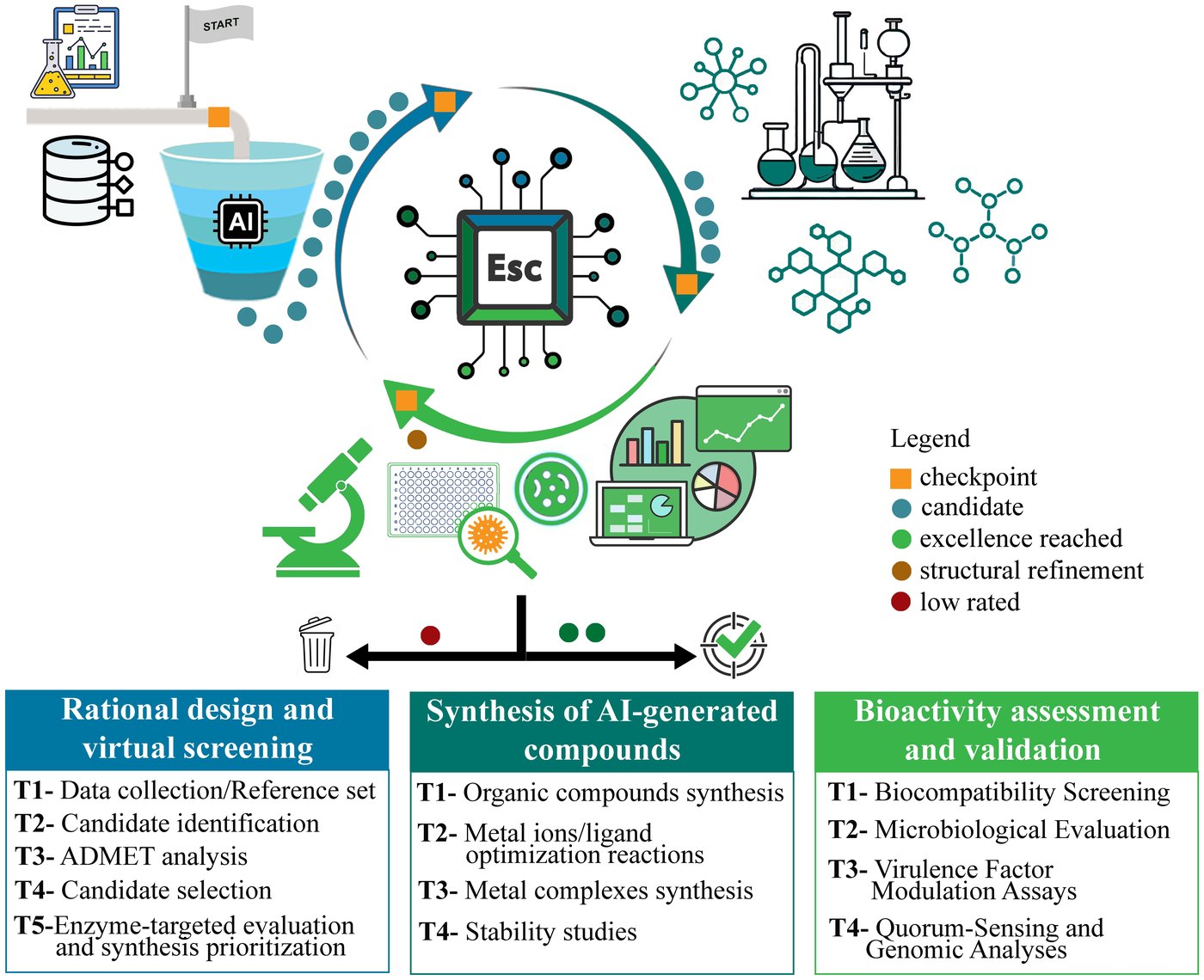
Five interconnected work streams that form the strategic project’s SmartLoop.
Machine learning and molecular docking for compound selection and design.
Organic ligands and metal complexes with optimal stability and solubility.
Antimicrobial and resistance-modifying activity against ESKAPE pathogens.
Cytotoxicity assays and structure–activity models linking in silico and experimental data.
AI, chemistry and microbiology in a circular, reusable framework for novel metal-organic agents.
Collaboration
Institutions involved in the ESCAPE FROM ESKAPE strategic project.
Methodology
We combine artificial intelligence, synthetic chemistry and microbiology to design, synthesize and evaluate new metal-organic compounds with antibacterial and resistance-modifying activity.